HomeAbout us
A journal with a long history.
Volkskunde is an independent Flemish-Dutch academic journal. Since 1888, it has examined and questioned the culture of everyday life in the Low Countries.
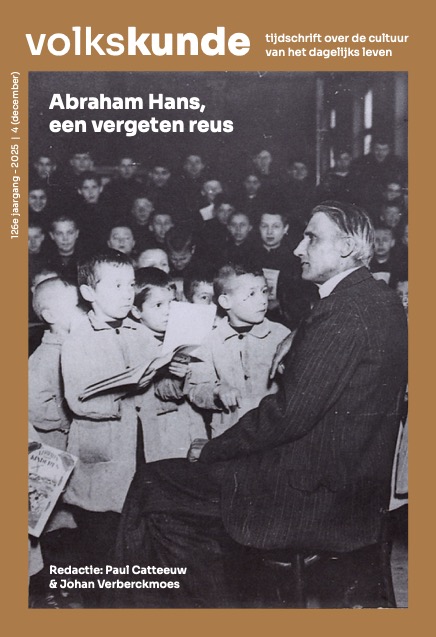
Identity and practices
The journal publishes on folklore and ethnology, cultural and historical anthropology, material and intangible heritage, and cultural and museum policy. Its editorial board is interdisciplinary and Flemish-Dutch.
Volkskunde is a recognised international academic journal with a peer-review procedure. Scholarly contributions are assessed in double-blind review by two anonymous referees; other contributions are assessed by the editorial board.
History
A. Gittée and P. de Mont founded the journal in 1888. A. De Cock became an editor in 1894. Publication paused from 1914 to 1920. A new series began with volume 43 in 1940–1941. In 2012, the series took its current form from volume 113; P. Catteeuw and J. Verberckmoes have led visual and final editing since 2021.
The official history page acknowledges support from the Flemish Government, the University Foundation, the Vera Himler Fund and Musea en Erfgoed Antwerp vzw. The current publishing administrator is Centrum voor Studie en Documentatie vzw.
Source: Volkskunde’s official history and support pages, consulted on 25 November 2026.
Sections for authors
- Scholarly articles
Research subject to a double-blind peer-review procedure.
- Essays and new research
Reflections, research plans and new research programmes.
- Traces (Sporen)
Notable finds and topics concerning the culture and heritage of everyday life.
- Reviews
Substantiated reviews of folklore publications.